
Electromagnetic compatibility, explained.
Every electronic product both emits electromagnetic energy and receives it. Electromagnetic compatibility (EMC) is the discipline that makes sure products work properly side by side — a phone next to a pacemaker programmer, a drive next to a radio, a charger next to a car.
This is a non-profit reference site. It has no product catalogue and no advertising. The aim is to give engineers, students, test technicians, buyers and regulators a clear, accurate picture of EMC.
Start here
- What is EMC? — emissions, immunity and the source–path–victim model.
- Coupling paths and noise modes — how interference travels, and why common-mode current matters.
- Regulations by region — EU, UK, USA, Canada, China, Japan, Korea, Australia and New Zealand.
- The standards map — CISPR, IEC 61000, product families, automotive, MIL-STD-461, medical.
Test methods
| Emissions | Immunity |
|---|---|
| Radiated emissions | Radiated immunity |
| Conducted emissions | Conducted immunity |
| Electrostatic discharge (ESD) | |
| Electrical fast transients (EFT/burst) | |
| Surge |
Facilities, design, vehicles
- Test facilities and site validation — open-area test sites, semi-anechoic and fully anechoic chambers, reverberation chambers, GTEM cells, shielded rooms.
- Design for EMC — grounding, shielding, filtering, PCB layout and cables.
- Automotive EMC — UN Regulation No. 10, CISPR 25, ISO 11452, ISO 11451, ISO 7637.
Reference
- Glossary and FAQ.
- Ask an EMC question — send a question through the contact form.
How the content is written
Pages describe principles, typical methods and where to find the official rules. They do not reproduce standards, which are copyrighted; always use the current edition of the standard and the official legal text for decisions. Points that could not be confirmed from official sources are marked Verify. Laws and standards change: each page shows when it was last reviewed.
This site gives general information, not legal or engineering advice.
All topics
Basics
- What is electromagnetic compatibility (EMC)? – EMC explained: the two halves of EMC (emissions and immunity), the source–path–victim model, the frequency ranges involved and why EMC is regulated.
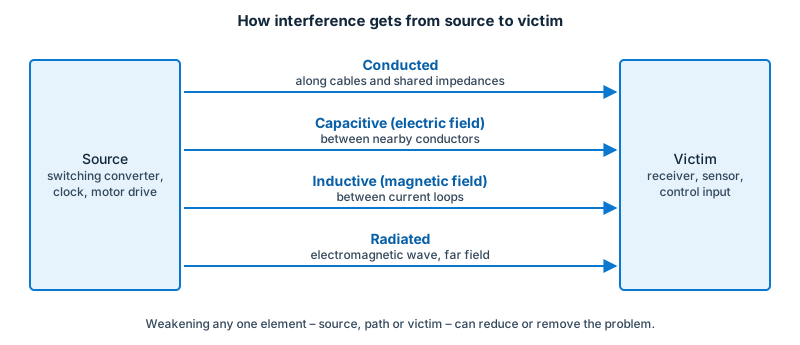
- Coupling paths and noise modes – How electromagnetic interference travels: conducted, capacitive, inductive and radiated coupling; differential-mode and common-mode noise; near field and far field.
- EMC frequently asked questions – Answers to common questions about EMC: what it is, who needs it, what tests are done, how to fix failures, pre-compliance, CE and FCC basics and more.
Emissions
- Radiated emissions testing – How radiated emission tests work: antennas, distances, turntable and height scan, detectors, frequency range, test sites and common sources of failure.
- Conducted emissions testing – How conducted emission tests work: LISN/AMN, frequency range, detectors, telecom ports, limits and typical causes of failure.
- Harmonic current emissions and voltage fluctuations (flicker) – What harmonics and flicker are, why equipment is limited (IEC 61000-3-2, 61000-3-3 and related standards), how they are measured and how designs comply.
Immunity
- Radiated immunity testing (IEC 61000-4-3) – How radiated radio-frequency immunity tests work: field generation, calibration of the uniform field, modulation, test levels, performance criteria.
- Conducted immunity testing (IEC 61000-4-6) – How immunity to radio-frequency conducted disturbances is tested: CDN, EM clamp and current injection, frequency range, levels and the 150 ohm reference.
- Electrostatic discharge (ESD) immunity testing (IEC 61000-4-2) – How ESD immunity tests work: the human-body model, contact and air discharge, indirect discharge, test levels, setup and what changed in the 2025 edition.
- Electrical fast transient (EFT/burst) immunity testing (IEC 61000-4-4) – What fast transient bursts are, how the EFT/burst test is applied to power and signal lines, waveform, repetition rate, test levels and common failure modes.
- Surge immunity testing (IEC 61000-4-5) – What surges are, how the combination-wave surge test is applied to power and communication lines, waveforms, source impedance and typical protection.
- Voltage dips, short interruptions and voltage variations (IEC 61000-4-11) – How immunity to supply voltage dips and interruptions is tested: causes, test generator, levels and durations, phase angles, and typical design fixes.
- Power-frequency magnetic field immunity (IEC 61000-4-8) – How immunity to 50/60 Hz magnetic fields is tested: sources, the induction coil method, test levels, and which products are sensitive.
Test methods
- EMC tests: an overview – The main families of EMC tests (emissions and immunity), what each checks, how test plans, performance criteria and laboratories fit together.
- Pre-compliance testing – How to find EMC problems early: near-field probes, current probes, artificial networks, spectrum analysers, and how to use margins and compare results with formal tests.
- Measurement uncertainty in EMC – What measurement uncertainty means in EMC tests, where it comes from, how CISPR 16-4-2 and ISO/IEC 17025 treat it, and how it affects pass/fail decisions.
Standards and regulations
- The EMC standards map: CISPR, IEC 61000 and product standards – A guide to how EMC standards are organised: CISPR emission standards, the IEC 61000 series, generic and product-family standards, and the automotive, MIL-STD-461, aerospace, railway and medical families.
- EMC regulations by region: an overview – How EMC is regulated in the EU, UK, USA, Canada, China, Japan, South Korea and Australia/New Zealand, with a comparison table and links to the official sources and the detailed region pages.
- EMC regulation in the European Union – The EMC Directive 2014/30/EU, the Radio Equipment Directive 2014/53/EU, harmonised standards, CE marking and the manufacturer's obligations.
- EMC regulation in the United Kingdom – The Electromagnetic Compatibility Regulations 2016 and Radio Equipment Regulations 2017 in Great Britain, UKCA marking, designated standards and Northern Ireland.
- EMC regulation in the United States: FCC Part 15 and Part 18 – FCC rules for unintentional and intentional radiators, Class A and Class B limits, measurement standards, equipment authorization and what the FCC does not regulate.
- EMC regulation in Canada: ISED and the ICES standards – How Canada regulates unintentional radio-frequency emissions through the ISED Interference-Causing Equipment Standards (ICES), ICES-003, labelling and radio standards.
- EMC regulation in China: CCC and radio type approval – How EMC fits into China Compulsory Certification (CCC), the role of the GB national standards based on CISPR, and radio type approval.
- EMC regulation in Japan: VCCI and the Radio Act – How EMC emissions from information technology equipment are handled in Japan through the voluntary VCCI scheme, and how radio equipment is regulated under the Radio Act.
- EMC regulation in South Korea: KC marking and the KN standards – How EMC is regulated in South Korea under the Radio Waves Act: the KC mark, the RRA, KN 32 and KN 35, and the conformity routes.
- EMC regulation in Australia and New Zealand: ACMA and the RCM – How the ACMA regulates EMC in Australia through supplier registration, the Regulatory Compliance Mark (RCM) and record keeping, and how New Zealand relates to it.
Test facilities
- EMC test facilities and site validation – The main EMC test environments — open-area test sites, semi-anechoic and fully anechoic chambers, reverberation chambers, TEM/GTEM cells, shielded rooms — and how test sites are validated.
Design for EMC
- Design for EMC: grounding, shielding, filtering, layout and cables – Practical principles for designing electronic products that pass EMC tests first time: PCB layout, grounding, shielding, filtering, cabling and early checks.
- Shielding for EMC: theory, apertures, seams and cables – How electromagnetic shielding works (reflection, absorption, skin depth), why apertures and seams dominate, gaskets, cable shields and shielded rooms.
- Filtering for EMC: topologies, insertion loss, placement and limits – How EMC filters work: differential and common mode, X and Y capacitors, chokes, filter topologies, insertion loss and why impedance, placement and parasitics decide performance.
Industries
- Automotive EMC: UN R10, CISPR 25, ISO 11452, ISO 11451 and ISO 7637 – How EMC works for vehicles and automotive electronics: the legal requirement (UN Regulation No. 10), component and vehicle test standards, transients, EV charging and the 07 series.
- EMC of electric vehicles and charging – EMC aspects of electric and plug-in hybrid vehicles: traction inverter emissions, charging-mode requirements in UN R10, off-board chargers, and the relevant standards.
- EMC of medical devices (IEC 60601-1-2) – How EMC applies to medical electrical equipment: the IEC 60601-1-2 standard, use environments, essential performance, risk management, emissions and immunity.
- EMC for railway applications (EN 50121) – Railway EMC: the EN 50121 series, how emissions from the railway system and the apparatus are treated, and the specific environment of traction power.
- Aerospace and MIL-STD EMC (MIL-STD-461, DO-160) – How EMC requirements for MIL-STD-461 and airborne equipment differ from commercial ones: MIL-STD-461 test codes, MIL-STD-464, RTCA DO-160 and EUROCAE ED-14.
Glossary and questions
Look up terms in the EMC glossary, or ask an EMC question.