Radiated immunity testing (IEC 61000-4-3)
How radiated radio-frequency immunity tests work: field generation, calibration of the uniform field, modulation, test levels, performance criteria.
A radiated immunity test checks that a product keeps working when exposed to a radio-frequency electromagnetic field, such as the field from a handheld transmitter, a base station or a broadcast tower.
The principle (IEC 61000-4-3)
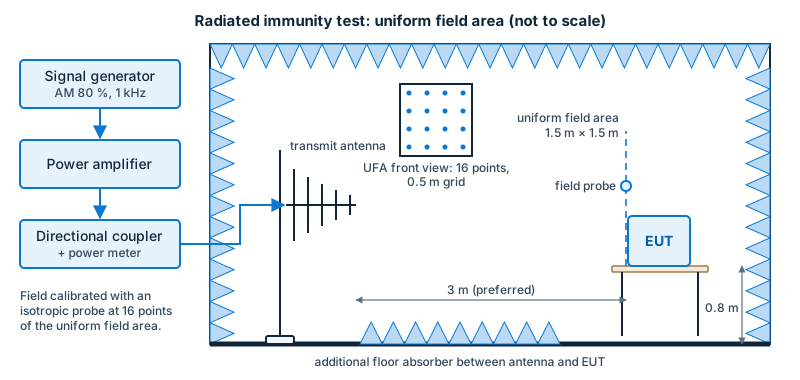
The common commercial method is described in IEC 61000-4-3 (European adoption: EN 61000-4-3). The EUT is placed in an electromagnetic field generated by an antenna driven by a signal generator and power amplifier, inside an absorber-lined room. The field is swept across the frequency range while the EUT is monitored for correct operation.
Key elements:
- Frequency range: from 80 MHz to 6 GHz in the current edition of the method (the product standard may require only parts of that range).
- Field strength: expressed in V/m (unmodulated). Typical levels are 1, 3 and 10 V/m, with higher levels for harsh environments; the product standard states the level.
- Modulation: the carrier is amplitude-modulated (typically 80 % depth with a 1 kHz sine wave) because many real-life interfering signals are modulated and because a modulated signal tends to reveal demodulation effects in the EUT. Other modulation (for example pulse modulation for GSM-type signals) is used where the product standard requires it.
- Polarisation and faces: the field is applied in horizontal and vertical polarisation, and the EUT is turned so that all relevant faces are exposed.
- Dwell time: at each frequency step the field stays long enough for the EUT to respond.
The uniform field and its calibration
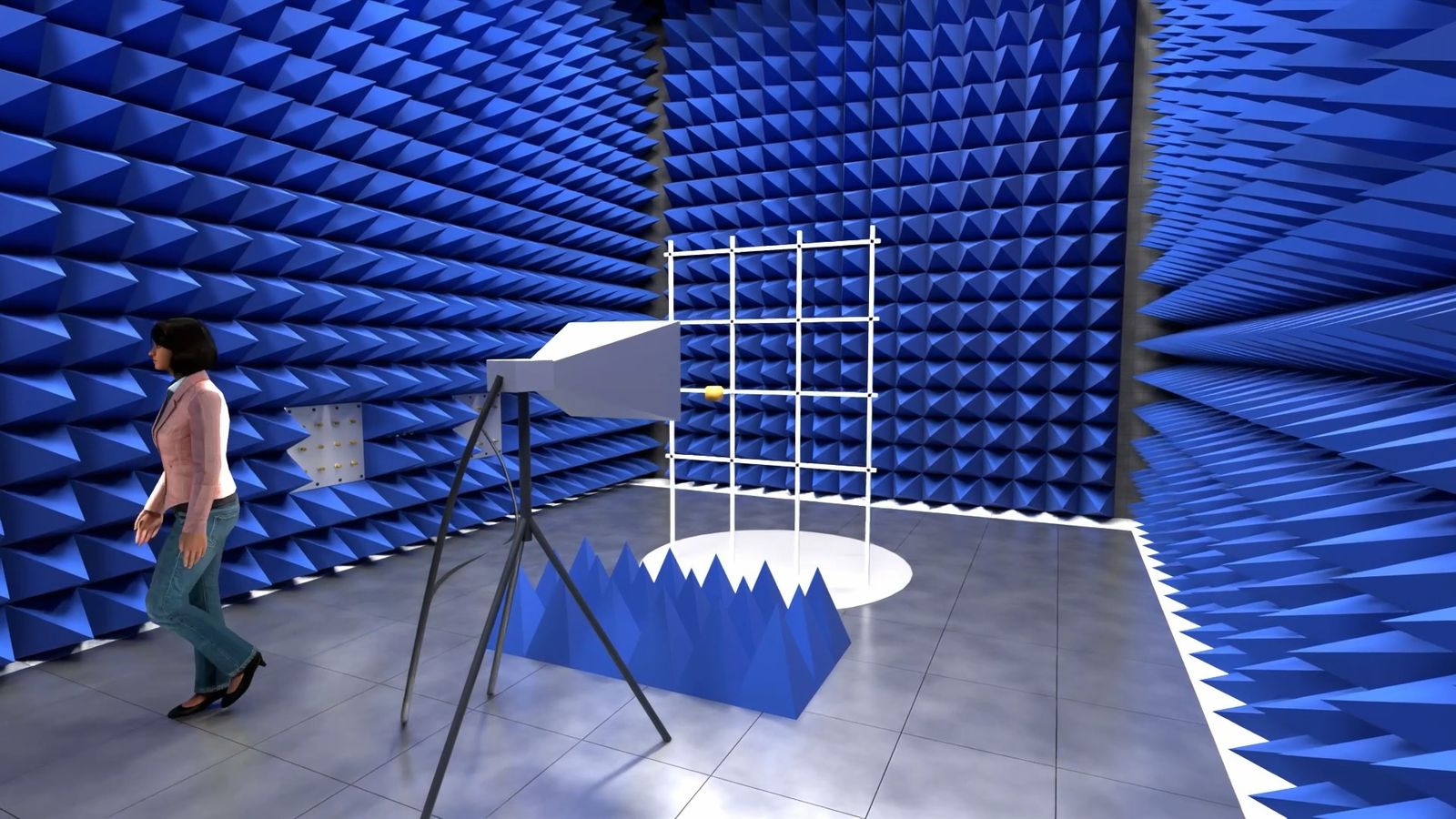
To make results repeatable the method specifies a uniform field area (a plane in space, in front of the antenna, where the EUT is placed). Before testing, the field is calibrated with an isotropic field probe at a grid of points (16 points on a square grid) without the EUT present. The method defines how many of those points must lie within a tolerance of the nominal level for the field to be accepted as uniform. During the test the generator level is set from the calibration data (the “constant-level” or substitution method).
Test rooms
Immunity tests need a space where the field is controlled and does not escape or enter. Common choices are a semi-anechoic chamber with additional absorber on the floor between the antenna and the EUT, or a fully anechoic room. See Test facilities and site validation. Other methods exist: TEM and GTEM cells (IEC 61000-4-20) and reverberation chambers (IEC 61000-4-21) with their own calibration approaches; they are used where permitted by the product standard.
Equipment
- signal generator with amplitude modulation;
- broadband power amplifiers (power is chosen from the field level, the antenna and the distance; harmonics must be low enough not to distort the test);
- transmitting antennas (bilog and horn types);
- isotropic field probe with fibre-optic link;
- monitoring (camera, loggers, communication interfaces) of the EUT.
Performance criteria
The standard does not say what “works” means; the product or generic standard does. The common classification is:
- A: normal performance within limits during and after the test;
- B: temporary loss of function or degradation allowed during the test, with self-recovery afterwards;
- C: temporary loss allowed if recovery needs operator intervention or system reset.
Each product defines its own criteria in the test plan (for example “the display may flicker but must not change the reading”).
Typical causes of failure
- Analogue inputs (sensors, audio) that demodulate RF (the rectifying effect of a semiconductor junction);
- cables acting as receiving antennas, with the field turned into common-mode current;
- microcontroller resets or clock disturbances caused by induced voltages;
- insufficient input filtering and poor shielding at cable entries.
Safety and compliance of the room
The generated fields are high; the room must be shielded and the generated field also must not exceed what the national radio rules allow outside. Test laboratories therefore work in shielded enclosures.