
Automotive EMC: UN R10, CISPR 25, ISO 11452, ISO 11451 and ISO 7637
How EMC works for vehicles and automotive electronics: the legal requirement (UN Regulation No. 10), component and vehicle test standards, transients, EV charging and the 07 series.
A modern vehicle contains dozens of electronic control units, sensors, motors and radios in a small space, powered from a noisy 12 V or 24 V supply (or a high-voltage traction battery). Automotive EMC therefore has three layers: the law (type approval), international test standards and manufacturers’ own specifications.
1. The legal requirement: UN Regulation No. 10
UN Regulation No. 10 (UN R10, often written ECE R10) sets EMC requirements for the approval of vehicles and of electrical/electronic sub-assemblies (ESAs). It is one of the UN Regulations annexed to the 1958 Agreement, administered by the UNECE World Forum for Harmonization of Vehicle Regulations (WP.29). Approval is granted by the approval authority of a country applying the Regulation, based on tests by a designated technical service, and is shown by the E mark (a circled E with the country number) and an approval number.
- Scope: vehicles of categories L, M, N, O, T, R and S (the category definitions are in the Consolidated Resolution on the Construction of Vehicles, R.E.3), and components and separate technical units intended for them.
- What it covers: emissions (broadband and narrowband radiated emissions, transients), immunity (radiated fields, transients) and, for vehicles with a charging connection, additional requirements in the charging mode (harmonics, flicker, conducted emissions, burst and surge immunity).
- Series of amendments: the 07 series entered into force on 12 June 2025 (document E/ECE/324/Add.9/Rev.6/Amend.4; authentic text ECE/TRANS/WP.29/2024/90). It is commonly called “Revision 7”. The earlier 06-series approvals remain valid and can be extended; from 1 September 2029 countries are no longer obliged to accept new approvals under earlier series.
- Main changes in the 07 series: vehicle immunity testing extended from 2 GHz to 6 GHz (levels above 2 GHz are lower than the existing ones), a new test-signal modulation scheme, the reverberation chamber newly permitted for ESA immunity, requirements for automated driving systems and emergency-call systems, separate conducted-emission limits for EV charging in residential and non-residential locations, an update of the transient pulse references, and deletion of the conducted-emission requirement on wired network ports.
For levels, bands and transitional provisions use the official text published by UNECE (WP.29); the summary above is drawn from published analyses and the 06-series text.
2. Component emissions: CISPR 25
CISPR 25 protects receivers on board the vehicle (AM/FM radio, digital broadcast, mobile and navigation receivers) from the electronics of the vehicle itself. The test uses a ground-plane bench in an absorber-lined shielded enclosure (ALSE):
- the component and its wiring harness (typically 1.5 m long, 50 mm above the ground plane) are laid out in a prescribed way and powered through artificial networks (5 µH/50 Ω is the common one for 12 V and 24 V supplies);
- conducted emissions on supply and signal lines are measured with receivers and detectors (peak, quasi-peak, average) from 150 kHz up to about 108 MHz;
- radiated emissions are measured with antennas at 1 m from the harness, from 150 kHz into the GHz range, using different antenna types in different bands.
The standard defines limit classes 1 to 5 (class 5 being the strictest) but does not itself tell you which class to use; the vehicle manufacturer chooses the class per component and location. UN R10 uses CISPR 25’s measurement methods and sets its own limits.
The band structure depends on the edition of CISPR 25; use the edition cited by the regulation or by the customer.
3. Component immunity: ISO 11452 series
The ISO 11452 series gives test methods for component immunity to narrowband radiated electromagnetic energy, with different coupling methods:
| Part | Method (summary) |
|---|---|
| ISO 11452-1 | General principles and terminology |
| ISO 11452-2 | ALSE (radiated field in an absorber-lined chamber) |
| ISO 11452-3 | TEM cell |
| ISO 11452-4 | Bulk current injection (BCI) and other harness excitation methods |
| ISO 11452-5 | Stripline |
| ISO 11452-7 | Direct RF power injection |
| ISO 11452-8 | Immunity to magnetic fields |
| ISO 11452-9 | Portable transmitters |
| ISO 11452-11 | Reverberation chamber |
UN R10 refers to ISO 11452-2, -3, -4 and -5 (and, in the 07 series, -11). Test levels depend on the method and on the specifications of the vehicle manufacturer, for example field strengths from 30 V/m for ALSE as in R10 up to 100 V/m or more in manufacturers’ specifications.
4. Vehicle immunity: ISO 11451 series
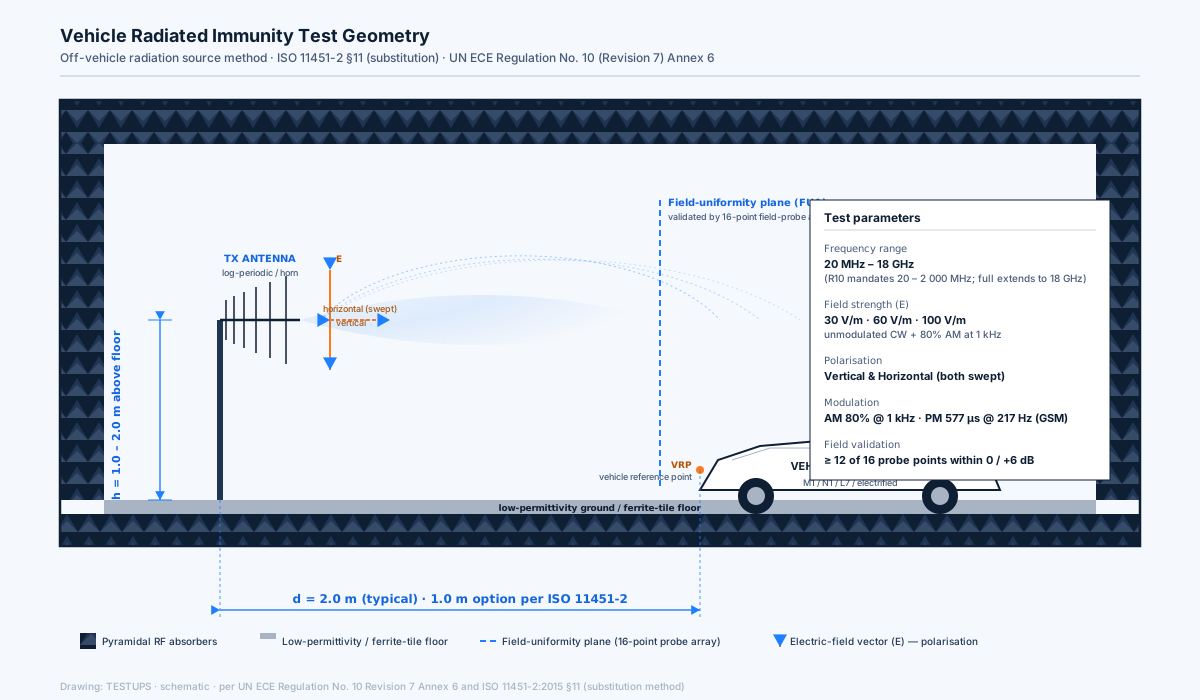
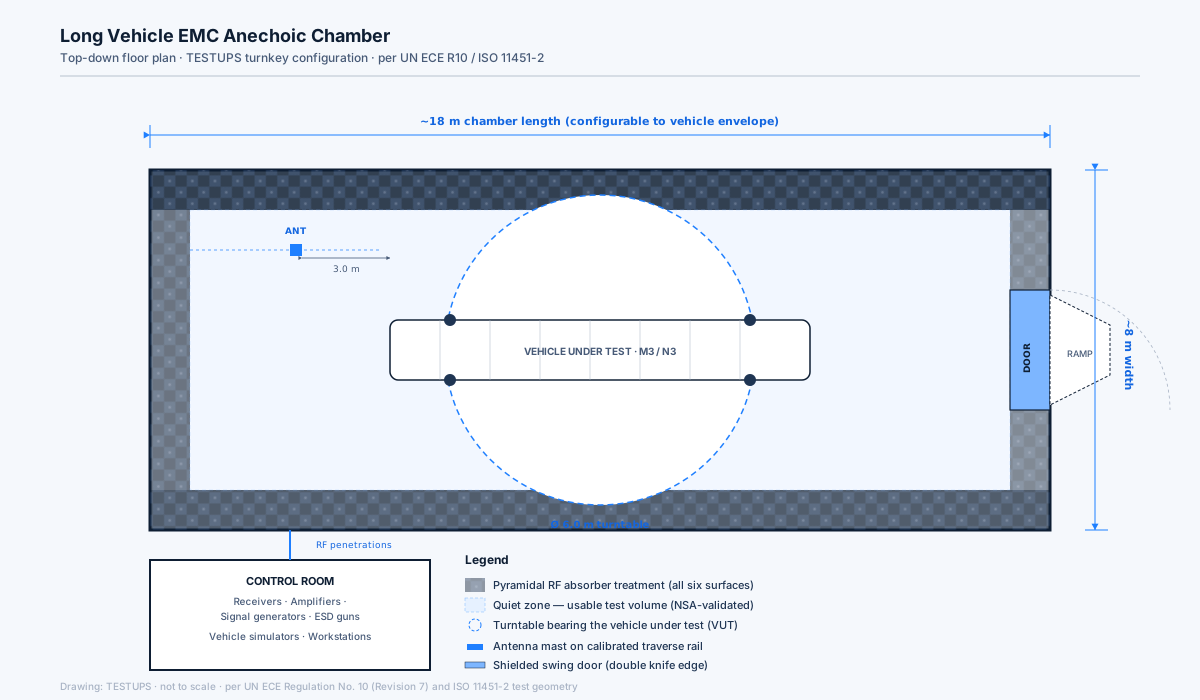
The ISO 11451 series covers immunity tests on the complete vehicle: general principles (part 1), off-vehicle radiation source in an absorber-lined chamber (part 2), on-board transmitter simulation (part 3) and bulk current injection (part 4). The vehicle is placed in a large chamber on a chassis dynamometer or a rolling road, operated in defined modes (for example driving at a constant speed or braking) and exposed to the field while its “immunity-related functions” are monitored.
5. Transients on the supply line: ISO 7637
ISO 7637-2 covers electrical transients conducted along supply lines in 12 V and 24 V systems, with standardised pulses that represent real events, for example:
- the disconnection of inductive loads (pulse 1),
- interruptions through the wiring inductance (pulses 2a and 2b),
- switching transients (pulses 3a and 3b),
- the voltage dips during engine starting (pulse 4).
ISO 7637-3 covers transients coupled by capacitive and inductive coupling to lines other than supply lines. ISO 16750-2 covers electrical loads (including load dump) as an environmental test. The functional status classification (which behaviour is acceptable during and after the pulse) is stated in the standard or by the vehicle manufacturer.
6. ESD: ISO 10605
ISO 10605 specifies ESD tests for automotive electronics. It differs from the general-purpose IEC 61000-4-2: it uses different discharge networks (for example 150 pF/330 Ω and 330 pF/2 kΩ) to represent a person sitting in the vehicle, and tests both powered and unpowered components and the packaging/handling case.
7. Electric vehicles and charging
Electric and plug-in hybrid vehicles add high-voltage, high-current power electronics (inverters, DC–DC converters, on-board chargers) and a charging interface to the grid. EMC aspects include:
- emissions from the traction inverter and cables (radiated and, at lower frequencies, magnetic fields);
- charging mode: UN R10 has charging-mode requirements for vehicles and ESAs, and standards such as IEC 61851-21-2 cover the EMC of off-board charging systems;
- high-voltage artificial networks for conducted measurements on high-voltage lines;
- protection of safety functions (steering, braking, battery management).
A further CISPR publication (CISPR 36) addresses emissions of electric and hybrid vehicles at lower frequencies; see EMC of electric vehicles and charging.
8. Off-board receivers: CISPR 12 and CISPR 36
CISPR 12 protects off-board receivers (for example a house TV or radio near a road) from vehicle and engine emissions, and is the base method for UN R10’s vehicle-level emissions test (30–1000 MHz, at 10 m or 3 m). CISPR 36 deals with electric and hybrid vehicles in a lower frequency range.
9. Typical test plan for a new component
- Which markets? (UN R10 approval needed, or only the customer specification?)
- Which vehicle manufacturer specification applies (levels, classes, operating modes)?
- Emissions: CISPR 25 conducted and radiated, in the ALSE.
- Immunity: ISO 11452-2 (ALSE), ISO 11452-4 (BCI), others as specified; ISO 7637-2/-3 transients; ISO 10605 ESD.
- Functional status criteria and monitoring defined in advance.
- Test report format agreed with the technical service and customer.